
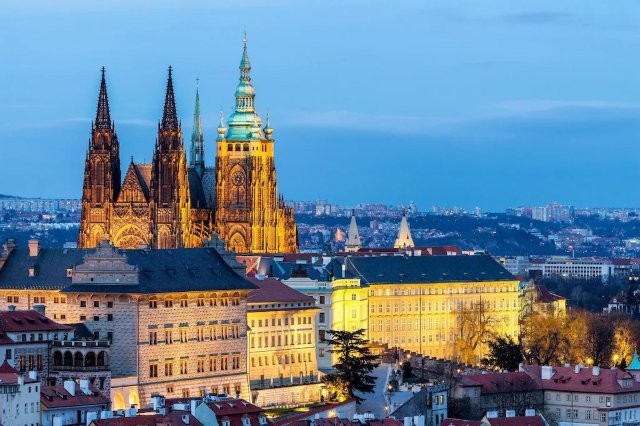
Our IPSW return to Prague again - after 10 years!
Last registration deadlines
Final Early Bird pricing deadline and lecture abstract deadline is March 29.
Deadline for participation on-site (full price) is April 12.
Unfortunatelly we can not accept any requests after this date.
Newsletters 2026
You can also find new information in the web version of our IPSW newsletters:
Schedule
Wednesday 13th May evening
- Participant registration and Welcome drink
Thursday 14th May
- Opening ceremony
- Scientific program – platform and poster presentations (two parallel sessions*)
- Evening social event I
Friday 15th May
- Scientific program – platform and poster presentations (two parallel sessions*)
- Closing remarks and acknowledgement of contributors
- Evening social event II
*Depending on the number of registered conference contributions
Hybrid structure
- Hybrid conference setup
- On-site – oral presentations and posters
- Online – presentation live broadcast and recording + book of abstracts
Detailed conditions will be specified at the second announcement according to the registered participant number.
Important dates
| Deadline Early Bird registration | Prolonged until March 29 |
| Deadline Abstract submission | Prolonged until March 29 |
| Deadline On site registration | April 12 |
| Notification of Acceptance | April 2 |
| Second Announcement | April 9 |
| Deadline Poster Submission | April 15 |
| Detailed Programme | April 30 |
Conference fees
| On site Early Bird registration | Normal – 500 EUR |
| Student – 375 EUR | |
| On site Late registration | Normal – 600 EUR |
| Student – 450 EUR | |
| Online Early Bird registration | Normal – 250 EUR |
| Student – 188 EUR | |
| Online Late registration | Normal – 300 EUR |
NORMAN satellite workshops
Workshop 1 - NORMAN Joint Programme of Activity 2026 „QUASIMEME“:
Meeting the Challenges of Reliable Analysis of Passive Samplers (PS) for Hydrophilic & Hydrophobic Compounds – Needs and Insights from Interlaboratory Comparisons (ILC)
Reliable chemical analysis is essential for accurate environmental risk assessment and informed management decisions. While laboratories implement internal QA/QC procedures, participation in Proficiency Testing and Interlaboratory Comparisons (ILCs) remains critical to ensure data comparability and analytical performance.
Over the past 12 years, WEPAL-QUASIMEME, Centre RECETOX at Masaryk University, University of South Bohemia and PaSOC have organised several ILCs for passive samplers (PS) analysing hydrophilic and hydrophobic compounds in surface water and WWTP effluent. Results reveal substantial variability between laboratories, with median coefficients of variation of 31% for hydrophobic compounds and 41% for hydrophilic compounds, both exceeding the EU Water Framework Directive target of 25%.
While previous efforts have not yet succeeded in clearly linking method information to laboratory performance, it is widely recognized that sample processing undoubtedly contributes to performance variability.
Organised within the framework of NORMAN JPA 2026, this IPSW session/workshop aims to bring together laboratories and research institutes working with PS to present and exchange analytical methodologies, address current challenges, discuss the optimal design of the next ILC planned for 2027, and identify practical strategies to enhance analytical reliability and performance. The session/workshop offers a valuable opportunity to learn from peers, strengthen collaboration, support both individual and collective performance development, and contribute to enhanced data quality across the monitoring community.
Workshop 2 - NORMAN JPA 2026 „Plastic“:
Harmonizing and extending knowledge of polymer-chemical interactions to benefit both the passive sampling and plastic communities
The passive sampling (PS) community has, over two decades, established PS as a robust method for monitoring hydrophobic organic contaminants in different matrices, including water, air, sediments and biota. Thanks to an extensive understanding of chemical interactions between environmental matrices and well‑characterised sampler polymers, PS delivers time‑integrated, freely dissolved concentrations suited for regulatory and risk assessment objectives. In parallel, a rapidly growing plastic research community has demonstrated that plastic/polymeric materials in the environment (micro and nanoplastics) can act as sorbents for organic chemicals. Plastics also contain a range of additives to obtain desired mechanical, thermal or optical properties.
The same fundamental principles (diffusion and partitioning) and parameters (partition coefficients, diffusion coefficients) that govern chemical uptake into passive samplers also govern the interaction of chemicals and plastic additives with environmental plastics. Despite these shared mechanisms, these two research communities have developed largely in parallel, using overlapping but not harmonised methodologies. A major challenge to directly apply the gathered knowledge is that PS polymers (e.g., silicone, PE, POM) are well-characterised, while environmental plastics are far more diverse (e.g., PET, PP, PU, PVC, tyres/elastomers) and display a wider range of sorption behaviours due to differences in crystallinity, additives, weathering, and ageing.
There is growing scientific and regulatory interest in harmonising the understanding of polymer–chemical interactions across both fields to allow (i) more realistic modelling of contaminant distribution and transport in environments with high plastic loads, (ii) improved interpretation of data from microplastic surveys and passive sampling campaigns, (iii) better predictions for fulfilling the Environmental Quality Standards (EQS) within the WFD and MSFD, amongst others.
The NORMAN JPA aims to identify opportunities for stronger connections between the two communities. A first workshop is held within the PS community during the IPSW and, building on its outcomes, an online meeting will be organised after summer 2026 to bring together both the PS and plastics communities.
Scientific Committee
- Branislav Vrana, Masaryk University, Czech Republic
- Kees Booij, PaSOC, The Netherlands
- Cecile Miege, IRSTEA, France
- Elisa Rojo-Nieto, Helmholtz Centre for Environmental Research, Germany
- Fiona Regan, DCU Water Institute, Ireland
- Nicolas Estoppey, Norwegian Geotechnical Institute, Norway
- Sophie Lissalde, E2Lim, Limoges University, France
- Helene Budzinski, University of Bordeaux, France
- Emma Rae Knight, Norwegian Geotechnical Institute, Norway
- Damian Shea, Statera, US
Organising team
- Tomas Ocelka, E&H services Inc., Czech Republic
- Jiri Oceansky, E&H services Inc., Czech Republic
- Darina Ocelkova, E&H services Inc., Czech Republic